SPARQL Query Language
SPARQL queries RDF graphs, which is comprises a set of semantic triple, or RDF triple or simply triple. A triple is a set of three entities that constitutes a statement about semantic data in the form of subject–predicate–object statements (e.g., "DatasetX has license CC BY 4.0"). The importance lies in the triples, not the serialization. Serialization is just a way to write the triples down.
SPARQL allows for a query to consist of triple patterns, conjunctions, disjunctions, and optional patterns as well as to perform changes on data via SPARQL updates. It also supports aggregation, subqueries, negation, creating values by expressions, extensible value testing, and constraining queries by source RDF graph. The results of SPARQL queries can be result sets or RDF graphs.
Syntax
Before writing a SPARQL query it is important to define the namespace prefix bindings which are used int he query. A binging is a pair of a prefix name and the corresponting IRI. For instance, the following is a binding for schema and rdfs namespaces:
PREFIX schema: <http://schema.org/>
PREFIX rdfs: <http://www.w3.org/2000/01/rdf-schema#>
Most forms of SPARQL query contain a set of triple patterns called a basic graph pattern. Triple patterns are like RDF triples except that each of the subject, predicate and object may be a variable. A basic graph pattern matches a subgraph of the RDF data when RDF terms from that subgraph may be substituted for the variables and the result is RDF graph equivalent to the subgraph.
Examples
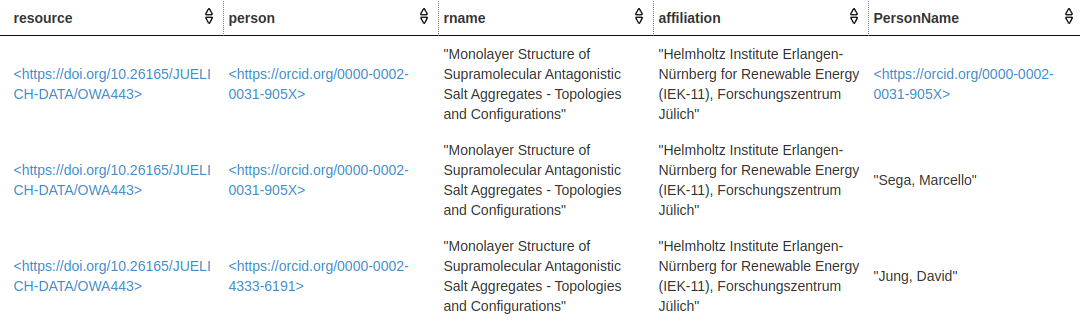
The example below demonstrates a simple query that leverages the publicatoins along with their authors. Specifically, the following query returns names and affiliation of every person participated in the creation of that resource:
PREFIX schema: <http://schema.org/>
SELECT *
WHERE {
  ?resource    schema:creator         ?person.
  ?resource    schema:name            ?rname.
  ?person      schema:affiliation     ?affiliation.
  ?person      schema:name            ?PersonName
}
The results will look like: